DOCTOLIB CONCEPT PROJECT
Leveraging AI to move real business metrics
An adaptive reminder engine targeting Doctolib's 22% no-show rate, tested against leading indicators of its north star.
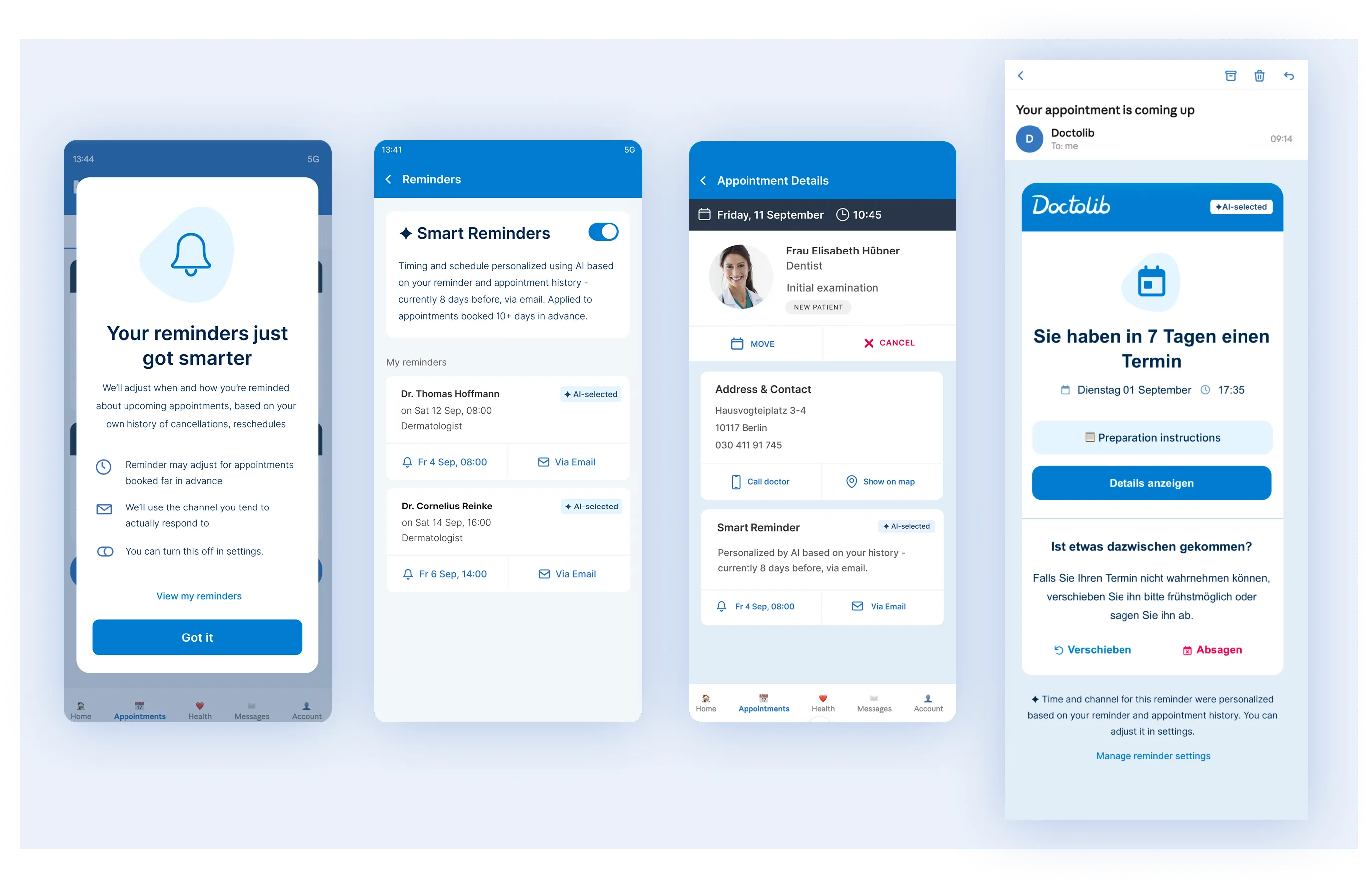
AT A GLANCE
- Problem
A 22% missed appointment rate, and one reminder schedule for every patient.
- Solution
Reminders that adapt timing and channel to each patient, learning from behavior and using no health data.
- Result
All 4 leading indicators passed with 15 testers. 14 of 15 would feel comfortable relying on Smart reminders instead of the standard reminders.
- ✦ My AI Craft
Confidence states for when the model isn't sure, guardrails it can never break, feedback loops that learn from real signals, and specs ML and engineering can build from.
- ✦ AI Workflow
Synthetic survey testing, AI-assisted research synthesis, logic mapping and specs with Claude as a sparring partner, prototyping in Figma Make
CONTEXT
A concept project for a doctor's appointment platform
Doctolib is one of Europe's largest digital health platforms, used by around 90 million patients and 520,000 healthcare professionals across five European countries. Patients use it to find doctors, book appointments and receive reminders before their visit.
I worked on this project as part of my "AI Design Expert" certification program in 2026. It is not affiliated with Doctolib. To keep it as realistic as possible, I worked with Doctolib's real product and regulatory constraints, alongside a simulated team.
MY ROLE
From AI opportunity mapping to engineering handover
I worked end to end as the AI product designer: finding the AI opportunity, running research, mapping the AI logic, designing and testing the interface, and writing the handover specs. The simulated team around me included a product manager, an ML engineer, a data scientist and a product sponsor. I shaped every deliverable around what each of them needs to do their job.
CHALLENGE
Finding AI opportunity in a highly regulated health context
According to the project brief, 22% of appointments in Germany are missed, costing practices €45 per empty slot. The brief names three causes: forgetting appointments booked more than 10 days ahead, arriving unprepared, and duplicate bookings.
The task: find where AI genuinely helps, prototype and test it, and hand it over to ML, engineering and a sponsor, all in three weeks and within strict health-data rules (DSGVO) and transparency obligations for AI (EU AI Act).
PROCESS 01 | DISCOVER
Where AI helps, and where a rule is enough
Today, every patient on Doctolib gets the same reminder schedule. Before designing anything, I needed to find the one cause of missed appointments AI could solve better than that fixed rule. Three questions guided me: what data could AI legally use, how do existing AI products solve similar problems, and what do patients actually need?
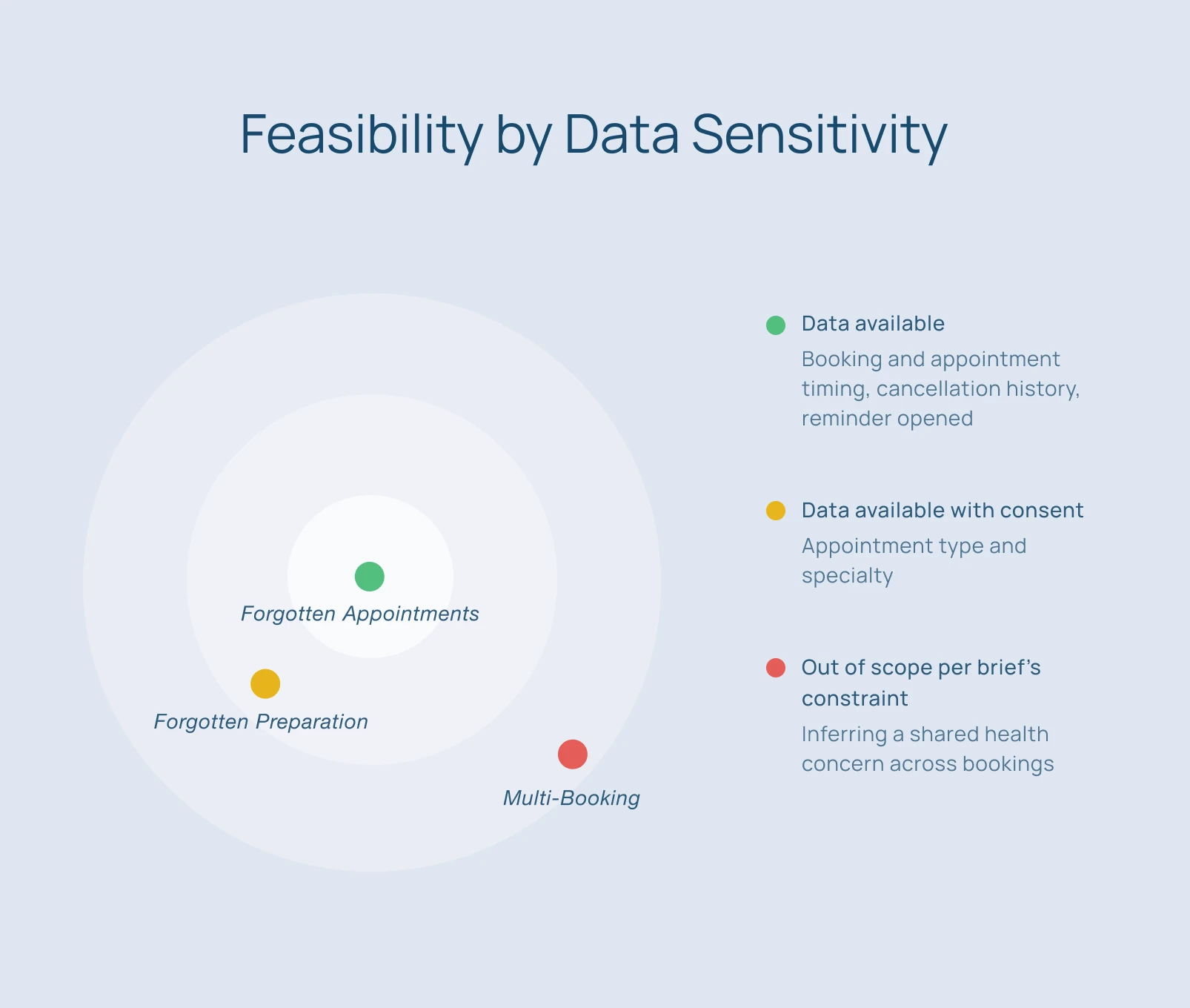
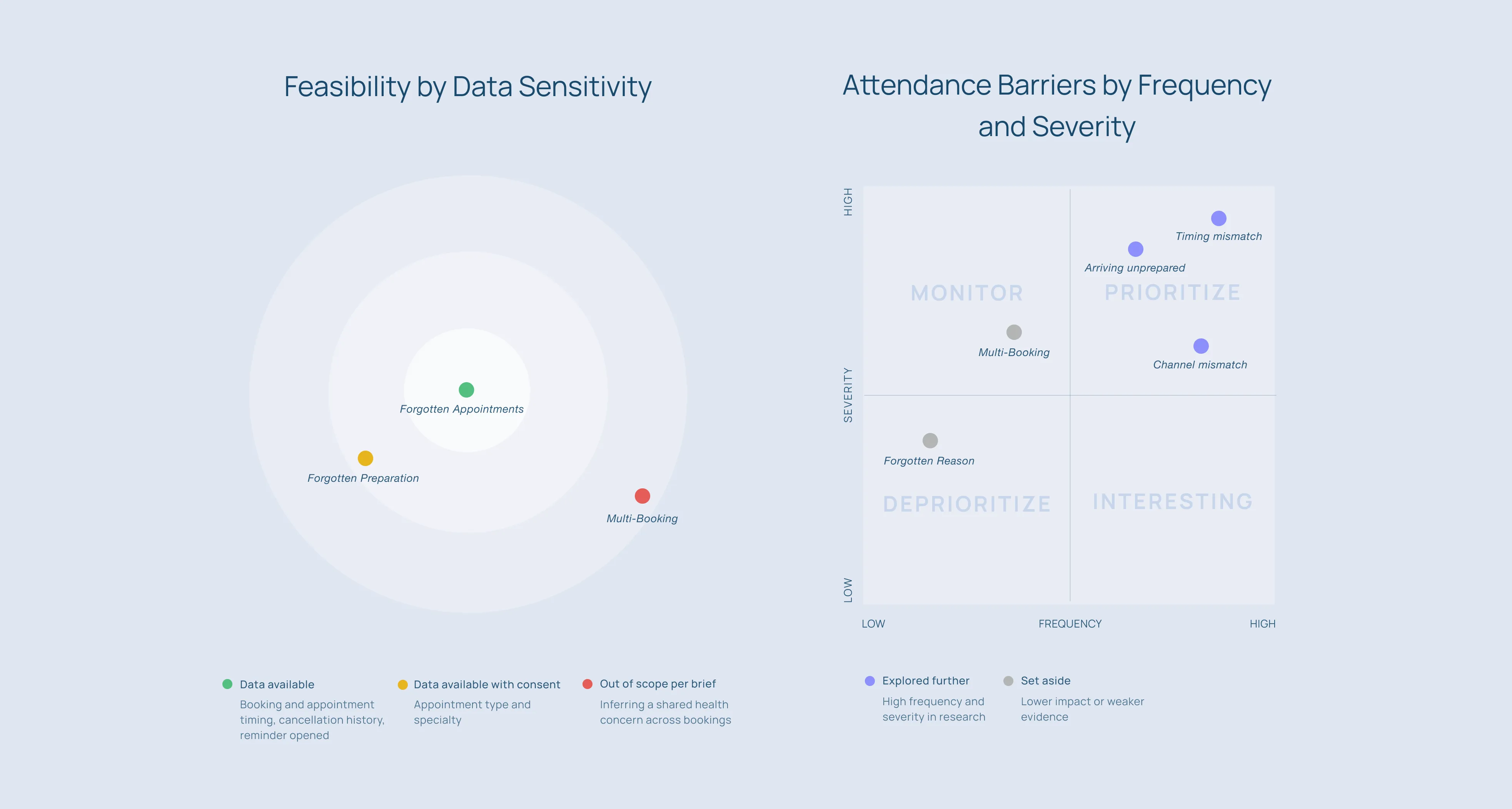
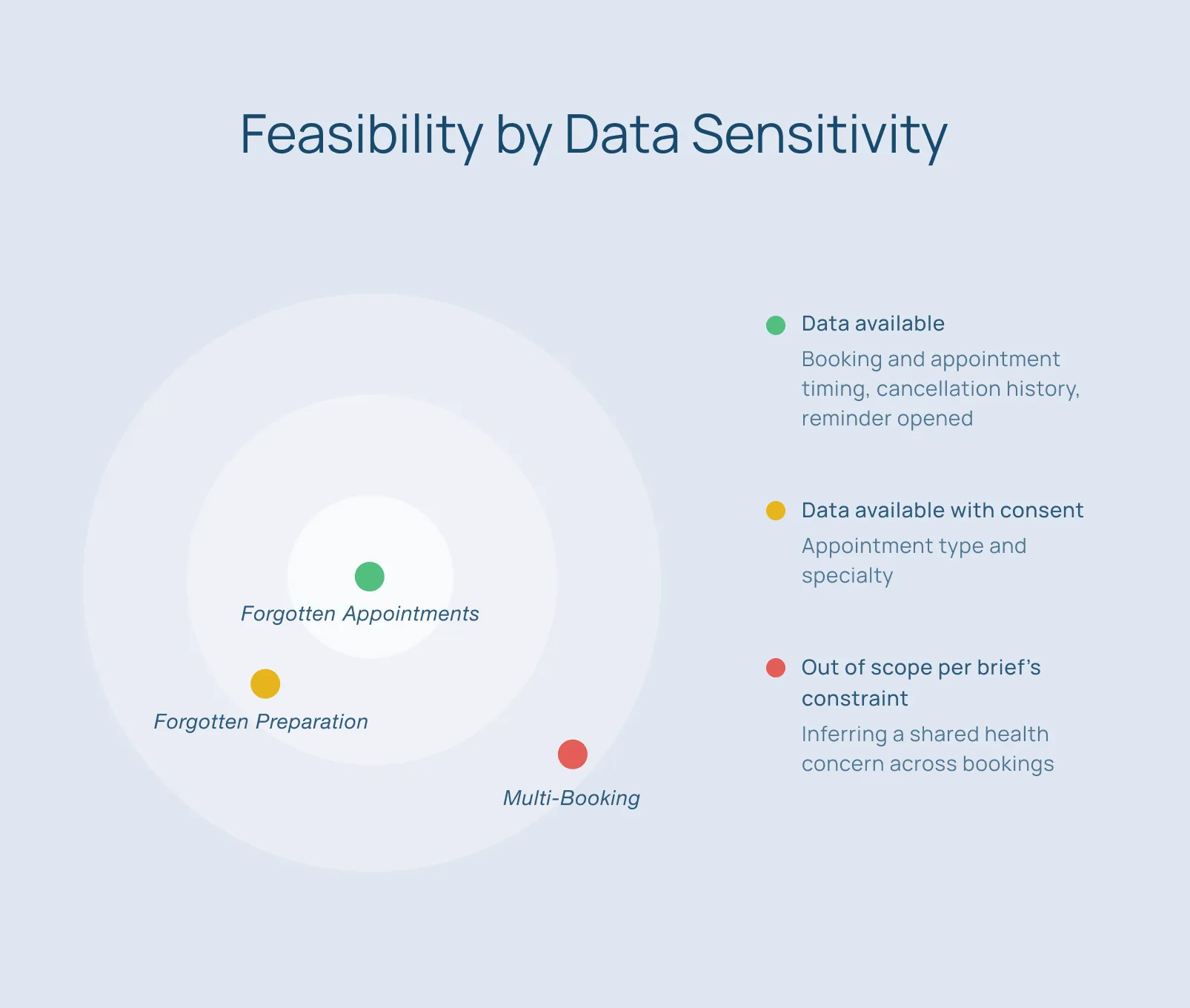
I ranked the brief's three causes by the data AI would need. The further a cause sits from the center, the more sensitive its data, and the harder it is to get and to justify. Forgotten appointments only need data Doctolib already has: booking and appointment timing, cancellation history, and whether a reminder was opened. Forgotten preparation would need appointment type and specialty, which requires consent. Multi-booking would mean inferring a shared health concern across bookings, which the brief ruled out. That left forgetting as the one cause AI could tackle without touching health data.
I studied two AI products that replace one-size-fits-all reminders with individual ones.
Duolingo's adaptive reminder timing. A fixed daily reminder doesn't match how each user actually responds, so engagement fades. Duolingo's reminder system uses a bandit algorithm: it keeps trying different options and learns, user by user, what gets a response, measured by whether the app is opened within two hours. Research on notification systems describes this as a way to learn individual delivery windows instead of one fixed time for everyone. The takeaway for me: a reminder system can learn when to reach each person from their own behavior.
Changi General Hospital: predicting MRI no-shows. The hospital in Singapore trained a model on almost 33,000 real appointments to score each upcoming scan's no-show risk from ten factors. Staff then call only the 25% most at risk, instead of everyone. No-shows dropped by 17.2%, and by 30.5% in a follow-up a year later. The limitation: the intervention is a human phone call, so it proves the prediction logic, not an automated reminder.
Both also revealed my biggest open risk: their models learned from clean signals like app opens or actual attendance, while Doctolib can't yet tell "forgot" from "decided not to go".
I worked with five interviews, one additional transcript and a survey with 10 respondents. Before sending the survey, I tested my 11 questions on eight synthetic personas. Some questions produced almost identical answers, so I cut the redundant ones. Synthetic responses never counted as findings, but one pattern was worth checking: trust in AI didn't follow age. An older persona trusted it completely, while a younger one refused any use of his health data. Real respondents were split as well, which confirmed my decision not to use health data at all.

The strongest signal was timing. 6 of 10 respondents named forgetting as the reason for a missed appointment, and two interviewees with long booking gaps said the single day-before reminder came too late. Both found about two weeks ahead useful. Channels were just as personal: one participant missed an SMS over the TV, another turns off push notifications right away. All three transcript participants relied on self-built workarounds they admitted were unreliable. Trust came up in every transcript. Two participants had been let down by health tools that sounded confident but weren't careful, and all three preferred hedged, honest language over confident answers that might be wrong.
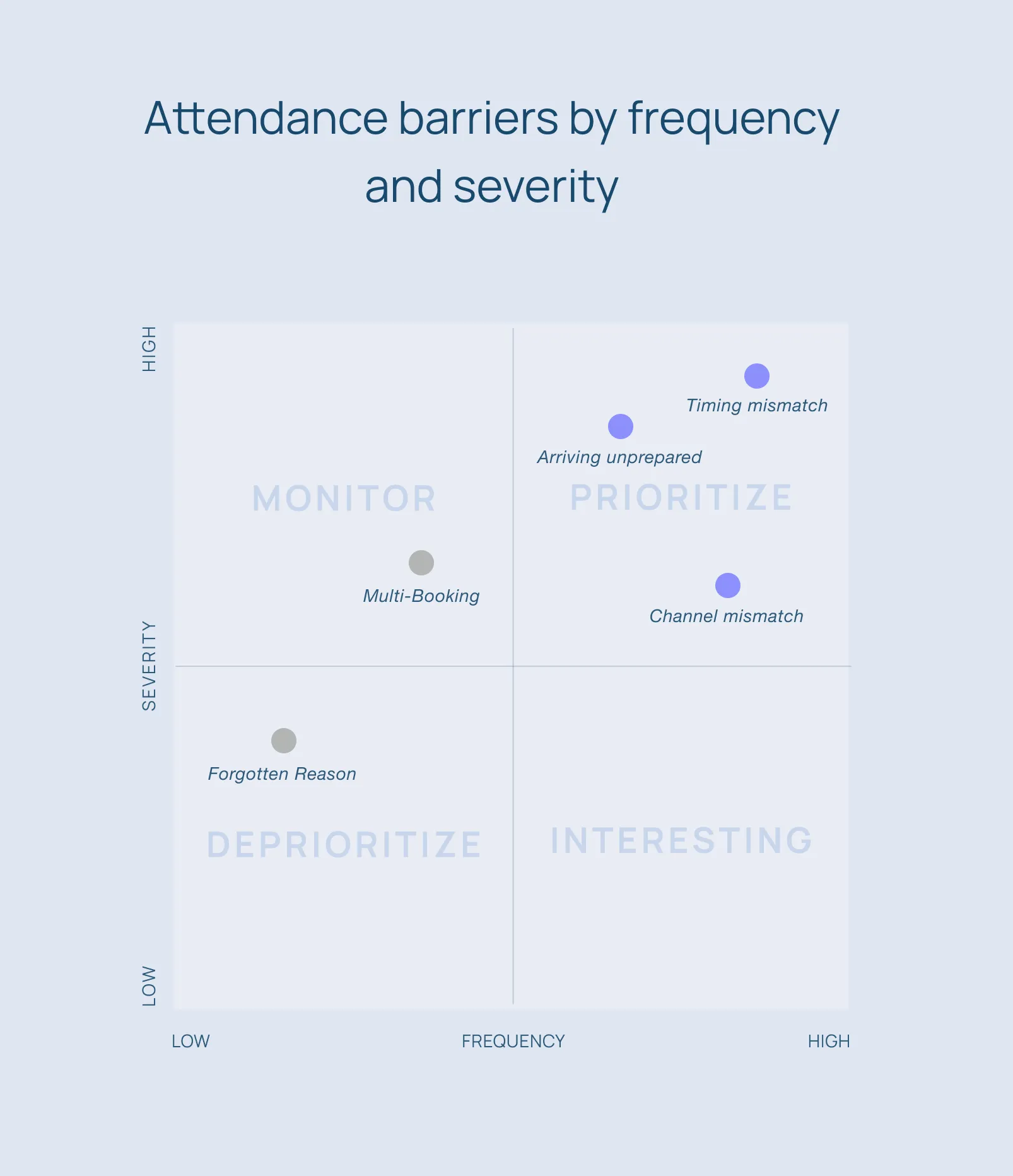
In a real project, I'd start with Doctolib's no-show data to see which cause drives the most missed appointments. Without it, I mapped every pattern from research by how often it appeared and how severely it affected attendance. Four insights stood out:
- Timing was the strongest signal. It was the only pattern confirmed by three independent sources: two interviewees described the same mechanism, and 6 of 10 survey respondents named forgetting. It also needs only data Doctolib already holds.
- Channels are just as personal. One participant wanted SMS and email, another push and email, a third needed phone calls. There was no single best default to find.
- Preparation fails on visibility, not content. Participants forgot a referral letter, a medication pause and a vaccination booklet, although Doctolib already shows preparation instructions on the appointment page.
- Forgotten reason for booking was downweighted. One interviewee described it clearly, but 9 of 10 survey respondents remembered why they booked.
RESEARCH OUTCOME
Where patient needs and legal limits meet
The answers all pointed in one direction. Patients mostly forget long-booked appointments because one fixed reminder arrives too late or through a channel they don't notice. Forgetting is also the one cause AI can tackle with data Doctolib already has, without touching health data. And existing AI products show that learning from each person's behavior can work. The two diagrams show where patient needs and legal limits meet.
The research left me with one clear AI opportunity, one problem that needed no AI at all, and a hypothesis to test. Before design began, I wrote up the full reasoning, risks and AI analogues for the team in an AI opportunity note.
RESEARCH OUTCOME
Reminders that adapt timing and channel are the strongest AI opportunity for Doctolib.
No AI where it's not needed
Making prep instructions more visible needs no AI and no new data, just a simple rule: patients who haven't opened their prep notes 3 days before the appointment get a separate prep reminder.
Hypothesis
I believe that patients who book more than 10 days in advance will forget fewer appointments when reminder timing and channel are personalized to their own history, measured by the missed-appointment rate against the fixed-schedule baseline, excluding appointments they report as deliberately skipped.
Documentation for my team
PROCESS 02 | DESIGN
Honest, even when unsure
With the hypothesis set, I designed how the feature behaves: what patients see, what they control, and what the system does when it isn't sure. I explored four concepts using AI UX patterns, compared the two strongest, mapped the system logic, and wireframed every state.
Shape of AI is an open library of UX patterns for AI products. I used six of its pattern types, each answering one question: Wayfinder: how do patients get started with the feature? Input: how do patients tell the AI what they want? Tuner: how do patients refine what the AI does? Governor: how do patients keep oversight and control? Trust builder: why should patients trust the result? Identifier: how is the AI made recognizable?
I built two concepts from these patterns. Both share one choice: patients don't need to give any input, because the AI infers their preferences from behavior. They differ on the other five.
Concept 1: Quiet default, easy exit
For patients who want the feature to stay out of the way.
- Wayfinder: a one-time explainer
- Tuner: change a single reminder
- Governor: one opt-out toggle
- Trust builder: a basis statement on every reminder
- Identifier: an AI marker in settings only
Concept 2: Control panel for the skeptical
For patients who want proof and control.
- Wayfinder: an entry link on each reminder
- Tuner: intensity profiles (Minimal, Standard, Thorough)
- Governor: switch off timing or channel separately
- Trust builder: a log of past performance
- Identifier: an "AI-selected" or "Standard" tag on every reminder
The quiet default optimizes for the problem: personalization that works with minimal friction. The control panel optimizes for the relationship: trust and consent first, even at the cost of effectiveness. I compared both on user needs, available data, legal requirements and trust.

I weighted user needs and available data highest. Design can close gaps in trust and transparency, but not missing data or a need patients don't have. The quiet default led on both: it uses only data Doctolib already holds and asks nothing of patients. Its weak spot was visibility: the basis statement explained why a reminder came at that time, but not that the AI had chosen it. With the brief's AI transparency requirement, and the risk that patients skip the statement as filler, that wasn't enough. So I borrowed the control panel's AI marker. It makes the AI visible on every reminder, which closes both the trust and the transparency gap. This was the final concept:
FINAL CONCEPT: Quiet default, visible AI
For patients who want the feature to stay out of the way, but want to know when AI is involved.
- Wayfinder: a one-time explainer
- Input: none needed, the AI infers preferences from behavior
- Tuner: change the time and channel of a single reminder in settings
- Governor: one opt-out toggle in settings, linked from every email reminder
- Trust builder: a basis statement on every reminder, in appointment details and in settings
- Identifier: an AI marker on every reminder, and an "AI-selected" or "Standard" tag on the reminder list in settings (borrowed)
The trade-off: personalization is all or nothing. A patient who likes the AI's timing but not its channel choice can only fix single reminders or switch the feature off completely. Single adjustments also don't teach the AI for next time. I accepted this to keep settings simple for patients who don't want to manage them.
One risk I carried into testing: would patients read the basis statement, or skip it as filler?
AI logic map: what the system does when it doesn't know
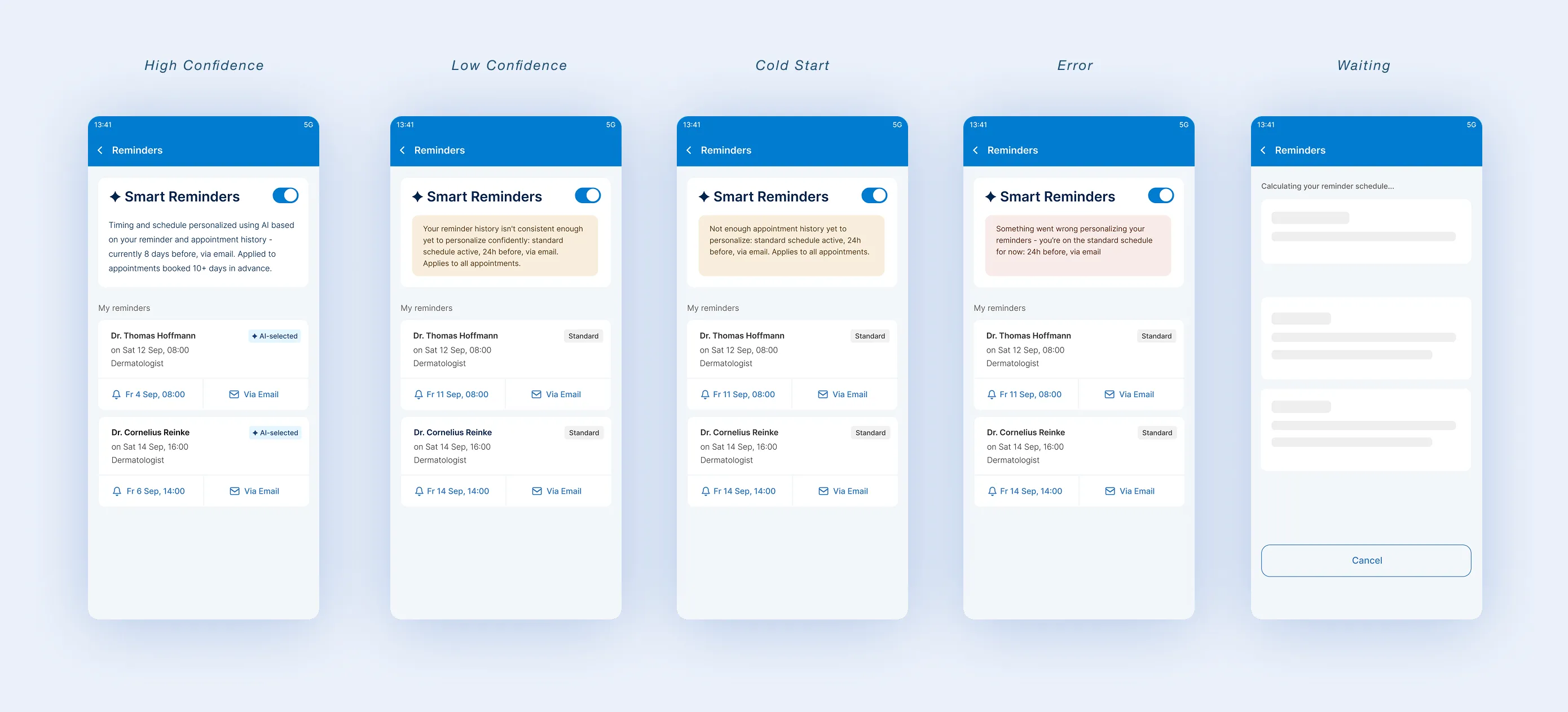
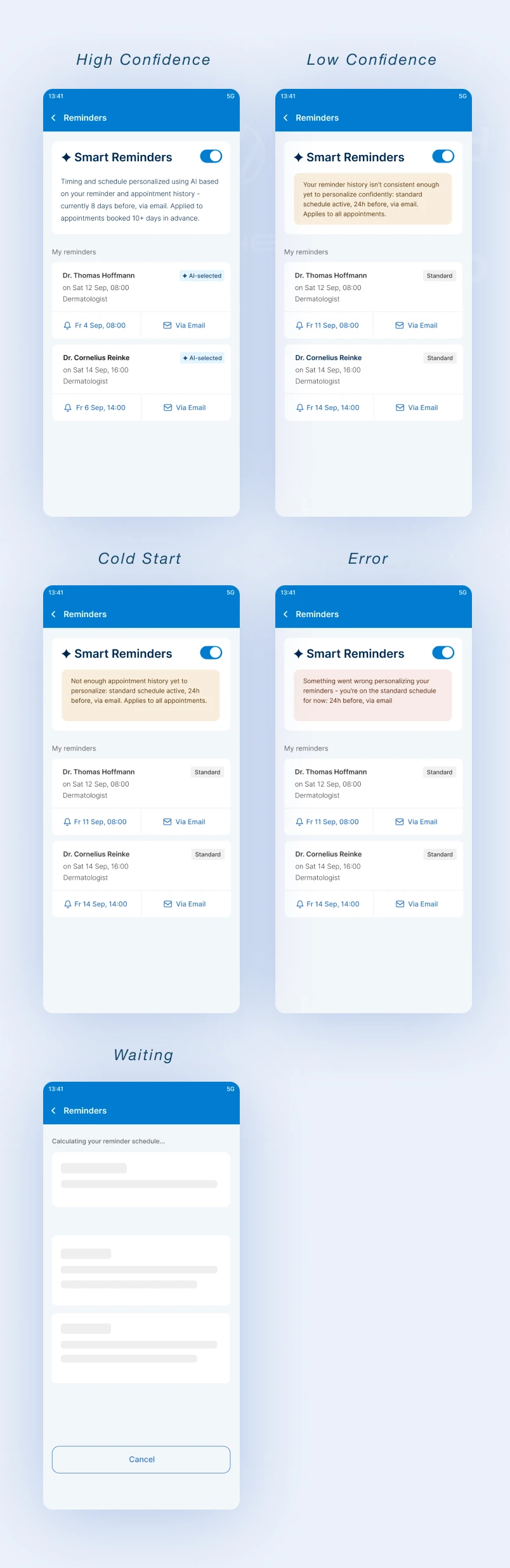
Before wireframing, I mapped how the system decides, what it shows when it isn't sure, and what it learns from. I defined five states: high confidence, low confidence, cold start, error and waiting. Every uncertain state falls back to the standard schedule, but tells the patient a different, true reason. Errors are checked before cold start, so patients with broken data are never told they're simply "new".
The system learns timing and channel from each patient's history, and a post-miss prompt separates "forgot" from "chose not to go". Personalization can only send reminders earlier or add channels, never later, fewer or none.
Wireframing five confidence states with no false certainty
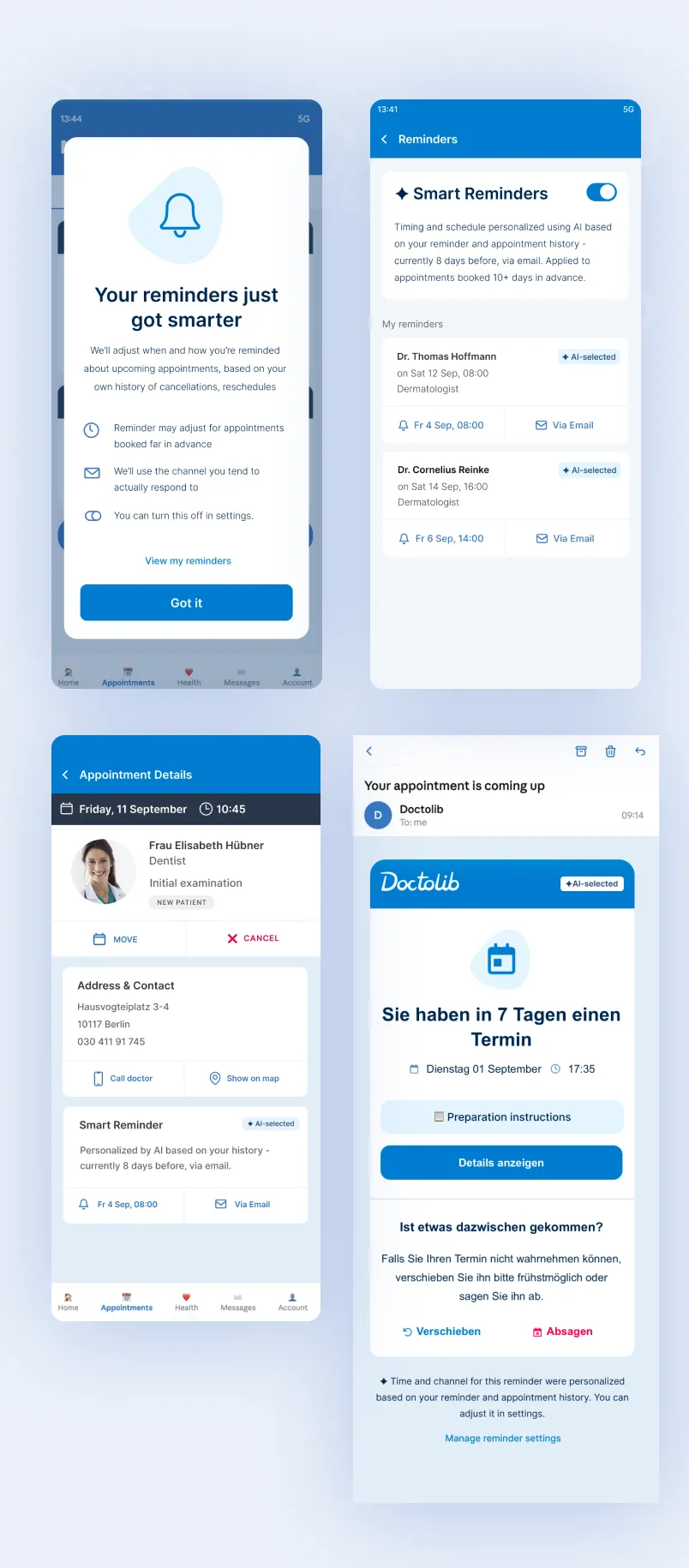
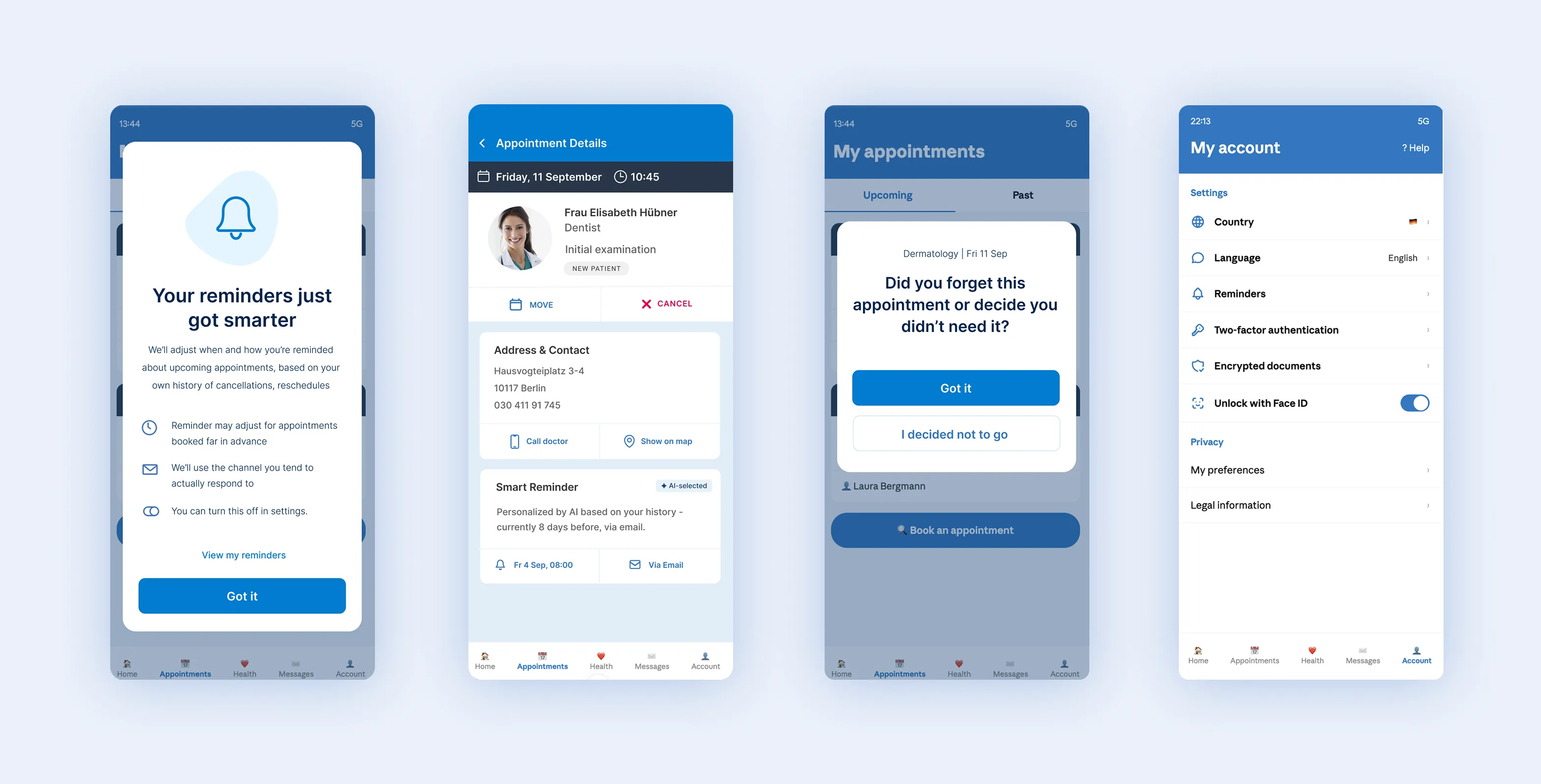
I wireframed all five states at iPhone 16 Pro size in Doctolib's visual language. Instead of separate screens, they're variants of one reminder list: every appointment is tagged "AI-selected" or "Standard", and each uncertain state explains itself in plain language.
Transparent at every touch point
Every reminder says whether it was AI-selected and why. Patients meet the feature through a one-time explainer, and can adjust or switch it off in settings, reachable from appointment details or any email. Within the three-week project, I designed email as the first external channel.
PROCESS 03 | VALIDATE & HANDOVER
Tested with users, specced for the team
To make the logic map and wireframes testable, I wrote a design context brief: one source of truth for every state, rule and line of copy, including what must never appear, such as a confidence score.
I then built an interactive prototype with Figma Make, generating it from my wireframes and the brief. Because the brief was this precise, Figma Make built it close to spec. Every state was reachable, so testers could complete tasks without guidance. It tests the interface, not the model: predefined content stood in for the AI's output.
Testing the leading indicators
The north star, fewer forgotten appointments, can only be measured after launch. So I tested its leading indicators first, each with a pass threshold set before testing: can patients find their controls, understand the AI's explanations, and trust it more than a fixed schedule?
In an unmoderated Maze test with 15 participants, finding the controls was measured by task completion, understanding by testers explaining the basis statement and first-time explainer in their own words, and trust by a direct question.
The results, against thresholds set before testing: 13/15 found how to adjust a reminder (70% needed), 14/15 explained the basis statement correctly (90% needed), 12/15 understood the first-time explainer (70% needed), and 14/15 would feel comfortable relying on Smart reminders instead of the standard reminders (70% needed).
These results validate the interface, not the outcome. Testers saw predefined AI output and all five states side by side, so understanding and trust may be lower in real use.
Handing over to the team
A concept is only as good as what the team can build from it. I prepared a handover for each role, so everyone could take the feature forward without me in the room.
Product manager
PRD: problem, user and business requirements, success metrics, rollback trigger, compliance and open questions.
ML engineer and data scientist
Handover document: data requirements, feedback loop, cold start and signals to instrument. System prompt and JSON payloads: output rules and data structure for every state.
Engineering
Annotated wireframes: every state, its triggers and constraints, and where each signal is captured.
Product sponsor
A 7-slide deck covering the problem, why AI, the risks and how success is measured.
THE HARD CALL
Ethics over efficiency: never less than the baseline
An adaptive system can quietly learn to send less support to patients it predicts will skip anyway. It saves messages and looks efficient, but it fails exactly the patients who need reminders most. So I ruled it out: personalization can only add support, never reduce it, at any confidence level.
The trade-off: the model can't serve patients who want fewer reminders, like the interviewee who wanted 3 days' notice at most. For them, only adjusting single reminders and the off switch remain, in exchange for a system that can never fail a forgetful patient silently.
OUTCOME
Ready for the real test
All four leading indicators cleared their thresholds, and the handover covers everything a team would need to build. The next step is a controlled launch: comparing missed-appointment rates between personalized and fixed-schedule cohorts, with the PRD's rollback trigger as a safety net. Before that, data protection would need to review consent and the default-on toggle.
HOW I USED AI
A partner for speed and critical thinking, never for judgment
I worked AI-natively throughout, using AI to research, explore, build and document faster, while keeping every decision my own.
- Research: Claude assessed feasibility against the brief and clustered findings. Synthetic personas stress-tested my survey questions before real users saw them. When Claude claimed no participant had missed an appointment, I checked the transcripts and corrected it.
- Design: Claude acted as a critical partner during logic mapping, surfacing contradictions and unsourced assumptions.
- Prototype: I generated it in Figma Make from my wireframes and brief.
- Specs and documentation: Claude drafted first versions of every document, from PRD to system prompt, which I directed, challenged and corrected.
- This case study: written with Claude as an editor, built with Claude Code.
REFLECTION
✦ Designing for AI means designing for uncertainty
When we design non-AI products, we design a deterministic output, like an engineer with a blueprint: every wall ends up where we drew it. AI features are probabilistic: the same input can bloom into different results. So we design more like a landscape architect laying out a garden: we can't decide where every leaf will sprout, but we can prepare the beds where it grows, set the paths our visitors walk, put up the fences to define the limits that can't be crossed, and choose what gets pruned to guide the growth.
In this project, the happy path was the easy part. Most of my work went into the beds and fences: the moments the model isn't sure, like cold start, low confidence, errors and waiting. I learned that honest uncertainty builds more trust than confident guesses, and it's why I now design every state before polishing the ideal one.